
OSHA Compliance Checklist for Contracting Businesses
Quick answer: OSHA compliance for a contracting business generally comes down to five things: a written safety program, up-to-date injury and illness recordkeeping (OSHA 300 logs), documented hazard-specific training, proper PPE and fall protection on-site, and posted required notices. Requirements scale with your workforce size and trade, and enforcement priorities shift year to year — 2026 is a good example of that, with a major proposed rule still unfinished.
| OSHA Requirement | What to Have in Place |
|---|---|
| Recordkeeping | OSHA 300 Log, 300A annual summary, and 301 incident reports when required |
| Written safety programs | Written safety and health program and hazard-specific programs as applicable |
| Hazard communication | Hazard Communication Program, Safety Data Sheets (SDSs), proper labeling, and employee training |
| Safety training | Documented training for fall protection, scaffolds, ladders, PPE, confined spaces, electrical hazards, and other applicable hazards |
| PPE and fall protection | Required PPE and appropriate fall protection systems available and used on-site |
| Job site safety | Safe electrical equipment, fire extinguishers, emergency access, guardrails, covers, and other required safeguards |
| Required postings | OSHA's "Job Safety and Health: It's the Law" poster and other required notices |
| State requirements | Compliance with applicable federal OSHA or state-plan requirements |
This checklist provides a general overview of common OSHA requirements for contracting businesses. Specific requirements vary based on your workforce, trade, work activities, and location.
Construction consistently ranks among the most heavily inspected industries, and OSHA citations aren't just a fine — they can shut a job site down, void insurance coverage, and follow your business into future bids. Here's what to actually have in place.
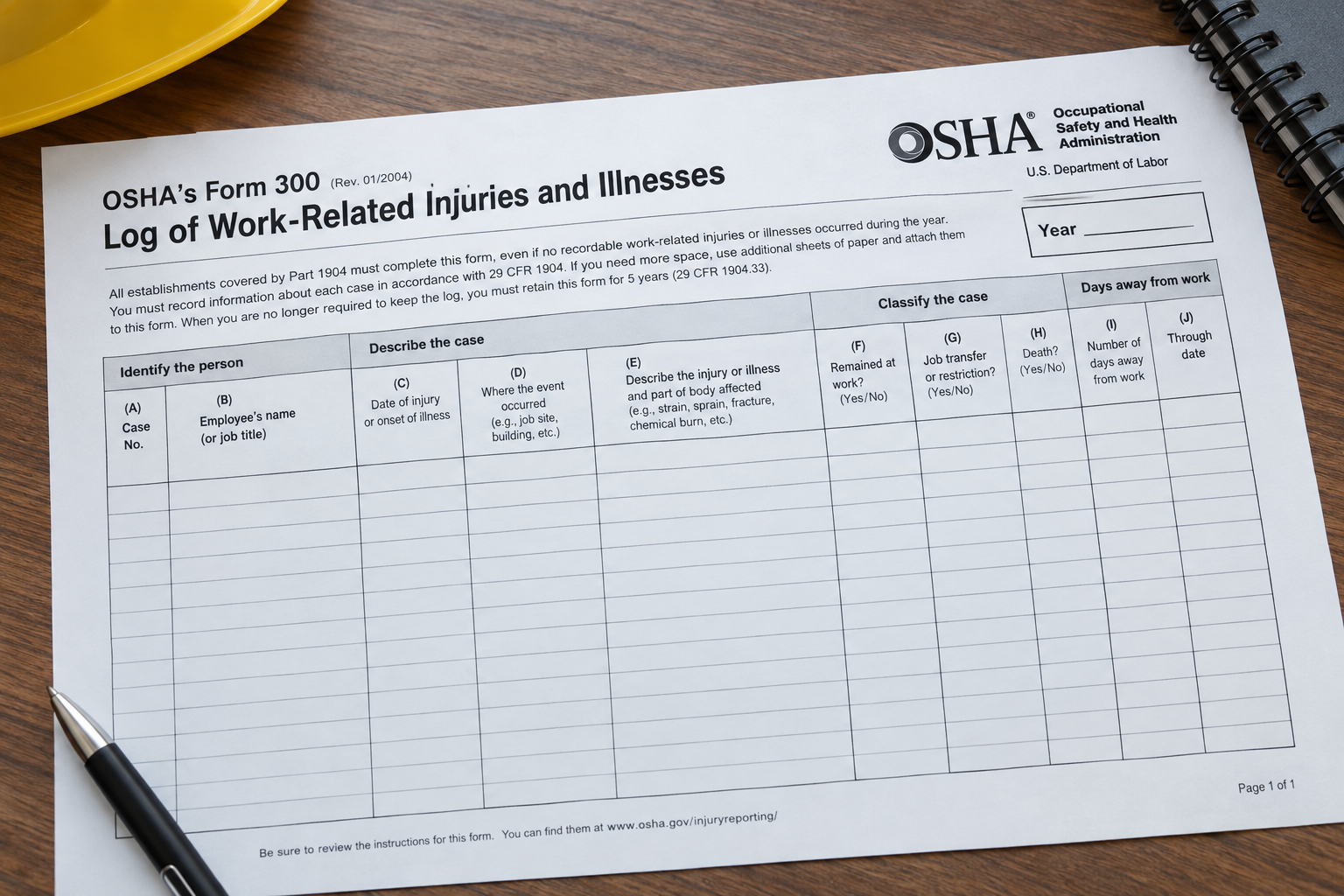
1. Recordkeeping: The OSHA 300 Log
If your business has more than 10 employees and isn't in a specifically exempted low-hazard industry, you're required to keep:
OSHA Form 300 — the injury and illness log, updated as incidents occur
OSHA Form 300A — the annual summary, which must be posted in a visible location from February 1 to April 30 each year
OSHA Form 301 — an incident report for each recordable injury or illness
Even businesses below the size threshold should keep basic incident records — it's the foundation of any workers' comp or liability defense, not just an OSHA requirement.
2. Hazard Communication and Written Programs
OSHA expects a written Hazard Communication Program if your crews work with any hazardous chemicals — which, on most job sites, they do (adhesives, solvents, coatings, fuels). This includes:
Maintaining Safety Data Sheets (SDS) for chemicals on-site
Properly labeling containers
Training employees on the hazards of chemicals they work with
Larger or higher-risk contractors should also have a written safety and health program covering general site hazards, not just chemical ones — this is often what an OSHA inspector asks to see first.
3. Training Requirements by Hazard
Training obligations depend on what your crews actually do, but common construction-industry requirements include:
Fall protection training — required for anyone working at heights of 6 feet or more in construction (fall hazards are consistently OSHA's most-cited violation category)
Scaffold safety training — for anyone erecting, dismantling, or working from scaffolding
Ladder safety
Personal protective equipment (PPE) training — specific to the PPE required for the task (hard hats, eye protection, hearing protection, respirators)
Confined space entry training — where applicable
Electrical safety / lockout-tagout — for anyone working around energized equipment
Training needs to be documented — who was trained, on what, and when. Verbal training with no paper trail doesn't hold up in an inspection.
4. Site-Level Requirements
On any active job site, OSHA inspectors typically look for:
Properly maintained and marked fire extinguishers
Clear, unobstructed emergency exits
Guardrails, covers, or other fall protection at open edges and holes
Properly grounded and maintained electrical equipment and temporary wiring
PPE actually being worn, not just supplied
A posted "Job Safety and Health: It's the Law" notice
5. State Plans and Local Rules
About half the states run their own OSHA-approved state plans, which can include requirements stricter than the federal minimum. If you work across state lines — which many trades do as they grow beyond a single region — you need to check whether a state plan applies in each location, rather than assuming federal rules alone cover you everywhere you work.
Where Federal Heat Illness Rules Actually Stand in 2026
There's a lot of inconsistent information online about a "2026 OSHA heat standard" — worth clarifying, because getting this wrong could mean under- or over-building your compliance program.
As of 2026, there is no finalized federal heat illness standard. OSHA proposed one — "Heat Injury and Illness Prevention in Outdoor and Indoor Work Settings" — back in 2024, and it went through public comment and a hearing process, but it has stalled with no confirmed date for finalization. In the meantime, OSHA continues to run a Heat National Emphasis Program, which directs inspectors to prioritize heat-hazard inspections in high-risk industries like construction, and the agency can still cite employers for serious heat hazards under its General Duty Clause even without a dedicated standard.
Practically, that means: don't wait for a final rule to have a heat safety plan. Several states (including California, Oregon, Washington, and others) already have their own binding heat illness prevention standards regardless of what happens federally, and OSHA can and does cite contractors for heat hazards today.
Penalties for Non-Compliance
OSHA penalties are adjusted for inflation each year and vary based on severity and whether a violation is repeated or willful. Categories generally include:
Serious violations — a hazard with substantial probability of death or serious harm
Willful violations — much higher penalties, for violations the employer knew about and didn't fix
Repeat violations — penalties that escalate sharply for a second citation of the same standard
Beyond the direct fine, an OSHA citation can also affect your Experience Modification Rate (EMR) for workers' comp, which raises your insurance costs, and can disqualify you from bidding on certain commercial or government contracts.
Stay Audit-Ready Without the Guesswork
Regulatory compliance shouldn't compete with running your jobs for your attention. TradesPro Services provides administrative support for OSHA safety compliance and contractor licensing, helping keep your safety records current and your renewal deadlines tracked before they become a problem.
Frequently Asked Questions
Do small contracting businesses need to comply with OSHA?
Yes. OSHA applies to virtually all private employers regardless of size, though some specific requirements (like maintaining an OSHA 300 log) have thresholds based on employee count and industry.
How often does OSHA inspect construction sites?
Inspections can be triggered by complaints, referrals, accidents, or programmed inspections targeting high-hazard industries — construction is consistently one of the most inspected sectors. There's no fixed schedule businesses can count on to predict timing.
What is the most commonly cited OSHA violation in construction?
Fall protection violations have topped OSHA's most-cited list for construction for years running, followed closely by hazard communication, scaffolding, and ladder violations.
Is there a federal heat safety standard I need to comply with right now?
Not yet — the proposed federal rule has not been finalized as of 2026. However, OSHA can still cite serious heat hazards under its General Duty Clause, and some states already have their own binding heat standards.
What records does OSHA require me to keep?
At minimum, businesses above the size threshold need an OSHA 300 injury/illness log, a 300A annual summary (posted each year), and 301 incident reports for recordable injuries, along with training records and any required written hazard programs.
