
1099 vs. Employee: How to Classify Workers on Your Contracting Crew
Quick answer: A worker is generally an employee (W-2) when a business has the right to control what the worker does and how the work is performed. An independent contractor (1099) generally operates an independent business and has greater control over how the work is performed. No single factor determines classification — the IRS considers the full working relationship, while the Department of Labor and state agencies may apply separate standards.
For contracting businesses, this question comes up constantly: a framer who works exclusively for you but supplies his own tools, a helper you pay by the day, a subcontractor who bills by the job. The line isn't always obvious, and the rules are shifting again in 2026. Here's how to get it right.
| Employee (W-2) | Independent Contractor (1099) |
|---|---|
| Business generally controls how, when, and where the work is performed | Worker generally controls how the work is performed |
| Often works on an ongoing basis for the business | Often hired for a specific project or service |
| Business may provide tools, equipment, and training | Worker generally provides their own tools and equipment |
| Usually paid wages or hourly/salary compensation | Often paid by project, invoice, or agreed rate |
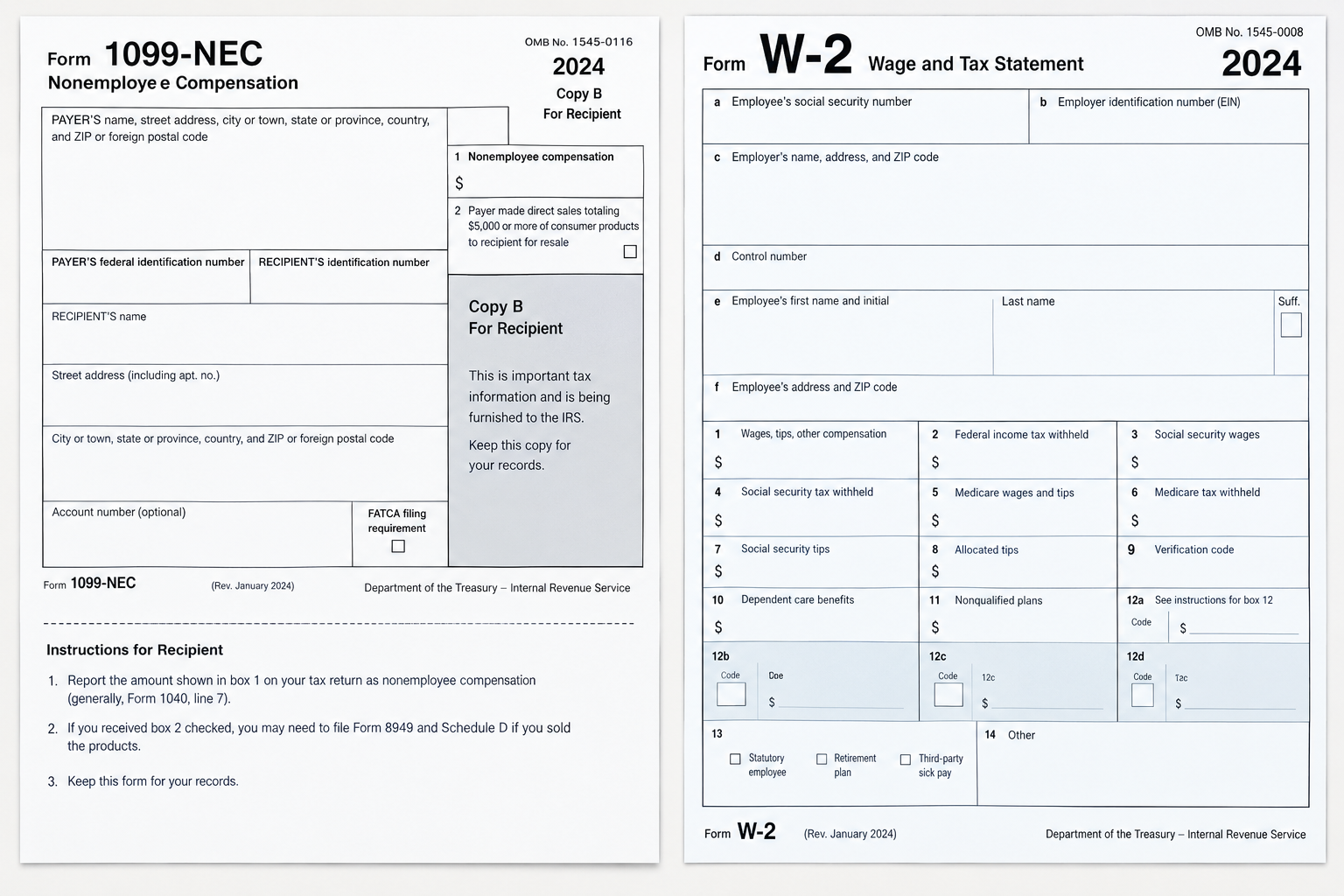
| Generally receives a W-2 | Generally receives a Form 1099-NEC when applicable |
| Business generally handles payroll tax withholding | Worker generally handles their own self-employment taxes |
| Work may be a core, ongoing part of the business | Worker typically operates an independent business or trade |
This table is a general comparison, not a classification test. Worker status depends on the specific facts and circumstances of the relationship.
Why This Matters More Than It Used To
Misclassifying a worker isn't a paperwork slip — it's one of the most expensive mistakes a contracting business can make. If a state agency or the IRS reclassifies a "1099 sub" as an employee, you can owe:
Back payroll taxes (Social Security, Medicare, unemployment) for every year the worker was misclassified
Unpaid overtime and minimum wage under the Fair Labor Standards Act
Workers' comp premiums you should have been paying
State-level penalties, which in several states are steeper than the federal ones
Potential liability for benefits the worker should have received
Construction and trades can face particular classification challenges because businesses may work with subcontractors, day laborers, and project-based workers in a variety of arrangements.
The IRS Test: Behavioral, Financial, and Relationship Control
For federal tax purposes, the IRS doesn't use a single checklist — it looks at three categories of evidence:
| IRS Factor | Questions to Ask |
|---|---|
| Behavioral control | Who controls when, where, and how the work is performed? Who provides training or instructions? |
| Financial control | Who provides tools and equipment? Who bears expenses? Can the worker make a profit or loss? |
| Type of relationship | Is there a written contract? Is the relationship ongoing? Are benefits provided? Is the work a key part of the business? |
No single factor determines whether a worker is an employee or independent contractor. The IRS considers the entire relationship and the degree of control and independence involved.
The DOL Side: What's Changing in 2026
Separately from the IRS test, the Department of Labor uses its own standard for wage-and-hour purposes under the Fair Labor Standards Act — and that standard has been a moving target. A 2024 rule made it harder to classify workers as independent contractors, but enforcement of that rule has effectively paused, with DOL field staff currently working from older guidance while a new rule works its way through the process.
In February 2026, the DOL proposed replacing the 2024 approach with a version closer to the framework used in 2021 — one that puts the most weight on two "core" factors: how much control the worker has over their own work, and whether they have real opportunity for profit or loss based on their own initiative and investment. That proposed rule's comment period closed in the spring of 2026, and a final version is expected later in the year.
What this means practically: The federal wage-and-hour standard is currently in transition. The DOL has proposed replacing the 2024 rule with a different economic-reality analysis, but the proposal is not the same thing as a final rule. It also only addresses federal wage-and-hour law and does not replace the IRS classification rules or state requirements.
Don't Forget State Law — It's Often Stricter
This is where a lot of contractors get burned. Several states use a much stricter "ABC test," which presumes a worker is an employee unless the business can prove all three of the following:
A — The worker is free from the company's control and direction in performing the work
B — The work is outside the usual course of the company's business
C — The worker is customarily engaged in an independently established trade or business of the same nature
Notice part B: if you're a general contractor and you classify your framers as 1099 subs, that's a hard argument to win in an ABC-test state, because framing is the usual course of a general contracting business. States with ABC-style tests or similarly strict standards include California, New Jersey, Massachusetts, and several others — and state agencies enforce these independently of whatever the federal rule says.
A Practical Self-Audit for Contracting Businesses
Run through this for each worker you currently classify as 1099:
Do they set their own hours, or do you require them on-site at specific times?
Do they bring their own tools and equipment, or do you supply them?
Could they realistically be doing the same kind of work for a competitor next week?
Do you pay them a flat rate per job/invoice, or a regular hourly/daily rate regardless of output?
Is the work core to your business (a GC's framing crew) or genuinely outside it (a one-time architect consult)?
Do you provide training on your specific methods, or do they already have the skill and just execute?
If most of your answers point toward "we control this," it's worth reviewing that classification with a professional before an agency does it for you.
Get Classification Right the First Time
Worker classification sits right at the intersection of payroll and HR — and it's exactly the kind of back-office decision that's easy to overlook when you're focused on running jobs. TradesPro Services provides payroll administration and HR compliance support for contracting businesses, helping you stay organized as requirements change.
Frequently Asked Questions
What's the penalty for misclassifying a worker as a 1099 contractor?
Penalties vary by state and by whether the IRS finds the misclassification intentional, but they typically include back payroll taxes, interest, and civil penalties — plus potential liability for unpaid overtime and benefits. Repeated or willful violations carry steeper fines.
Can a worker be a 1099 contractor for tax purposes but an employee under labor law?
Yes. The IRS test and the DOL/FLSA test are separate, and state tests are separate again. It's possible (though risky) for a worker to pass one test and fail another — which is exactly why classification decisions shouldn't rely on a single checklist.
Does having a signed independent contractor agreement protect my business?
Not on its own. A contract can support your position, but agencies and courts look at how the relationship actually works day to day, not just what the paperwork says.
Does a 1099 mean someone is an independent contractor?
Not necessarily. A Form 1099 is generally used to report certain payments to nonemployees, but receiving a 1099 does not by itself determine whether someone is legally an independent contractor. Worker classification depends on the actual working relationship, including factors such as control, financial independence, and the nature of the relationship.
How often should I review my worker classifications?
At least once a year, and any time a working relationship changes — for example, if a "one-off" sub becomes a regular fixture on your crew, or if you start setting their schedule.
Disclaimer: This article provides general information about worker classification and is not tax, legal, or employment-law advice. Worker classification rules vary based on the specific facts, applicable federal requirements, and state law. Consult a qualified tax or legal professional for advice about your specific situation.
